Private property & individual rights
The institutional foundation that makes long-range production, exchange, and economic calculation possible.
The Jefferson School presents
George Reisman's landmark synthesis of classical and Austrian economics—and a rigorous case for economic freedom, human progress, and laissez-faire capitalism.
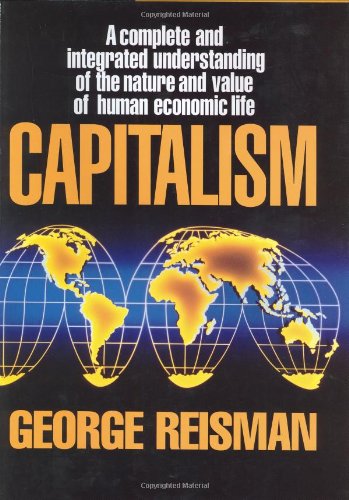
The definitive work
“The clearest and most comprehensive contemporary defense of the capitalist economic system available.”
Written for the intelligent general reader and the professional economist alike, Capitalism brings together the Austrian school's focus on individual action with enduring insights from the British classical economists.
Across twenty chapters, Reisman examines production, prices, wages, profit, saving, money, competition, monopoly, socialism, inflation, and the political foundations of a free society.
A framework for understanding
A systematic exploration of how freedom, production, prices, saving, and individual rights work together in a division-of-labor society.
The institutional foundation that makes long-range production, exchange, and economic calculation possible.
How specialization and voluntary exchange expand human productivity and mutual dependence.
Why free prices carry knowledge, balance supply and demand, and direct resources toward valued uses.
The role of productive investment in rising output, technological progress, and higher real wages.
Freedom of entry as a process of discovery, improvement, and expanding choice—not a fixed market structure.
A monetary analysis connecting credit, spending, purchasing power, and the recurring business cycle.
“Reisman's exposure of modern mercantilist fallacies takes its place alongside that of Adam Smith.”James M. Buchanan · Nobel Laureate in Economics, 1986
Inside the treatise
The book moves from first principles to the institutions of a market economy, then to the forces that drive economic progress.
Continue your study